Faith: Evaluating a Graffiti-Styled Color Font for Urban Design Projects
Understanding the Core Asset
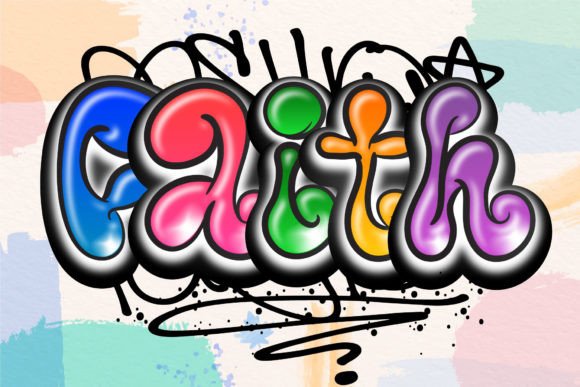
In the landscape of digital typography, finding assets that bridge the gap between artistic expression and technical functionality is a constant challenge for designers. Faith is a modern typeface that positions itself firmly in the "graffiti-styled" category, but it distinguishes itself through a specific technical implementation: it is a Color Font utilizing OpenType-SVG technology. Unlike standard vector fonts that rely on single-color fills, Faith is designed to render multi-colored gradients and textures directly within the font file. This allows the text to appear as if it were sprayed or painted onto a surface, complete with the visual depth and shading characteristic of street art.
The primary value proposition of Faith lies in its ability to inject an "urban touch" into digital compositions without requiring the designer to manually paint or texture individual letters. For professionals in branding, social media marketing, or apparel design, this font represents a shortcut to a specific aesthetic. However, as with any specialized creative asset, its utility is not universal. It requires a nuanced understanding of where it fits within a workflow and which tools are capable of rendering it correctly. This evaluation aims to dissect Faith’s practical application, compatibility, and overall value for the modern creative professional.
Technical Specifications and Workflow Integration
The most critical aspect of Faith that professionals must understand is its file format. As an OpenType-SVG font, Faith carries embedded color data and bitmap information. This is a distinct departure from standard OTF or TTF files, which are purely vector-based outlines. The inclusion of SVG data allows the font to maintain complex textures and color shifts, but it also imposes specific software requirements.
Faith is explicitly compatible with major design software including Adobe Photoshop, Adobe Illustrator, Silhouette, and Inkscape. These environments support the rendering of SVG fonts, allowing the full color palette and textured edges to display correctly. For a designer working in Photoshop, Faith functions almost like a stamp, delivering a high-fidelity visual immediately upon typing.
However, there is a significant limitation regarding cutting machines. The product notes clearly state that the OTF and TTF files are not compatible with Cricut. This is a crucial distinction for users in the crafting and DIY space. While Silhouette users can utilize the font, Cricut Design Space generally struggles with the complexity of color fonts, often reducing them to basic outlines or failing to recognize the file entirely. Therefore, Faith should be viewed primarily as a digital design asset rather than a universal crafting tool. It excels in screen-based applications, digital advertising, and print-on-demand services that support high-resolution rasterized text.
Visual Characteristics and Aesthetic Impact
From a visual standpoint, Faith delivers on its promise of an urban aesthetic. The letterforms are constructed with the loose, energetic flow associated with modern graffiti tags. The strokes vary in weight, mimicking the pressure of a spray can nozzle, and the internal shading creates a three-dimensional effect. This is not a font designed for body text or formal correspondence; it is a display typeface meant to command attention.
The "color" aspect of this color font is its strongest selling point. Traditional methods of achieving this look involve outlining text and applying complex clipping masks or layer styles. Faith simplifies this by baking the aesthetic into the glyph itself. This ensures consistency across every letter, which can sometimes be difficult to maintain when manually applying textures. For projects requiring a cohesive street-wear vibe—such as album covers, event flyers, or bold headline graphics—the visual consistency of Faith provides a professional finish that improvised texturing might lack.
Practical Application for Professionals
For the target audience—marketers, entrepreneurs, and creators—the practical application of Faith is specific but potent. Consider a small business owner launching a streetwear brand. The typography used on mockups, website banners, and social media assets needs to resonate with a culture of authenticity and edge. Faith allows for the rapid prototyping of these assets. A designer can type out a slogan, and it immediately looks like a custom graphic, saving hours of post-processing.
Similarly, educators and bloggers in creative niches can use Faith to create engaging thumbnails or header images. In the crowded digital space, a standard sans-serif font often fails to stop the scroll. The visual noise and texture of Faith can serve as a hook, drawing the eye to the content. However, it is vital to use this font sparingly. Its complexity makes it difficult to read in long sentences. It is best utilized for short, impactful phrases: "SALE," "LIMITED DROP," "NEW ARRIVAL," or "SUBSCRIBE."
Limitations and Considerations
While Faith offers a compelling visual solution, it is not without its trade-offs. The primary limitation, beyond the Cricut incompatibility, is file size and rendering. OpenType-SVG fonts are inherently larger than standard vector fonts because they contain image data. This can occasionally lead to slightly slower load times in web applications if the font is embedded directly (though this is becoming less of an issue with modern broadband speeds).
Furthermore, color fonts are still a relatively niche technology. While Adobe and Silhouette have embraced them, other platforms may render Faith as a standard black outline, stripping away its defining feature. Users must verify that their specific output environment supports color font rendering before committing to the asset. If the project involves sending editable files to clients who use older software versions, the "color" effect might be lost on their end.
Conclusion: Is Faith the Right Tool?
Faith is a specialized tool for a specific job. It is not a replacement for a standard workhorse font family, nor is it intended to be. Its value lies in its ability to instantly translate a concept—urban, raw, energetic—into a usable digital format. For professionals who frequently work with youth culture, music, streetwear, or high-energy event promotion, Faith is a valuable addition to the font library. It streamlines the workflow for creating textured typography and offers a level of polish that is difficult to replicate manually.
Ultimately, Faith fits best in the toolkit of a designer who understands its constraints and leverages its strengths. By respecting its software compatibility requirements and using it in the appropriate contexts—bold headlines and graphic elements rather than paragraphs of text—it serves as a reliable asset for adding that necessary urban edge to a project. It stands as a practical example of how font technology is evolving to meet the demands of modern, visually rich digital communication.