Vonca: Evaluating the Modern Minimalist Font for Your Next Design Project
In the vast and often overwhelming world of typography, choosing a font is rarely a simple matter of preference. It is a strategic decision that influences readability, brand perception, and the overall success of a visual composition. For designers working within contemporary frameworks, the demand for typefaces that balance aesthetic appeal with functional versatility is constant. Among the options that have garnered attention for their adherence to modern design principles is Vonca, a minimalist font family that prioritizes geometric precision and clean lines. This analysis explores the characteristics, applications, and comparative standing of Vonca to help professionals determine if it aligns with their specific creative requirements.
Understanding the Core Aesthetic: What Defines Vonca?
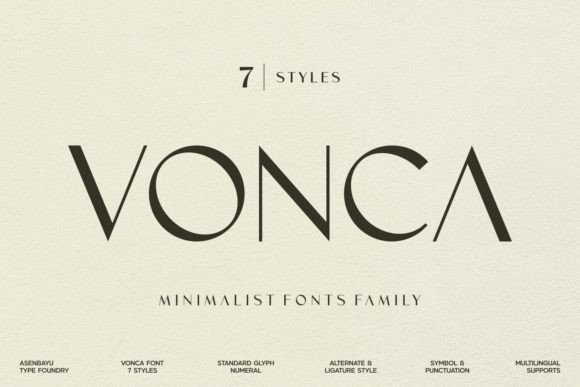
Vonca is fundamentally defined by its commitment to geometric construction and a sleek, uncluttered visual profile. Unlike transitional or humanist typefaces that may incorporate calligraphic flourishes or irregular curves, Vonca adheres strictly to clean, mathematical forms. This results in a typeface that feels efficient, structured, and distinctly contemporary. The letterforms often feature uniform stroke widths and precise terminals, contributing to a visual rhythm that is steady and predictable—qualities that are highly valued in modern minimalist design.
However, its utility extends beyond the purely modern. The inherent simplicity of Vonca allows it to bridge stylistic divides. When paired with the right color palettes, textures, and layout structures, it can effectively anchor vintage-inspired designs. In such contexts, the font provides a stark, legible counterpoint to more ornate visual elements, allowing the vintage character to emerge through imagery and context rather than through the typography itself. This duality is a key aspect of its versatility, making it a candidate for a broader range of projects than a font with a more aggressively futuristic or purely retro personality.
Practical Applications: Where Vonca Excels
The true test of any typeface lies in its application. Vonca's design characteristics make it particularly well-suited for specific use cases where clarity, modernity, and brand impact are paramount.
Branding, Logos, and Packaging
For logo and branding projects, especially those targeting a sophisticated, contemporary audience, Vonca offers a strong foundation. Its clean geometry ensures that logos remain legible across a wide range of sizes, from a tiny favicon on a browser tab to a large-scale signboard. In packaging design, particularly for sectors like cosmetics, tech accessories, or artisanal food products aiming for a "trendy" aesthetic, Vonca can deliver a premium and uncluttered look. The font’s ability to communicate efficiency and modernity without distraction helps the product itself remain the focal point.
Editorial and Environmental Design
In poster design and fashion-related layouts, Vonca functions as a powerful tool for creating hierarchy and emphasis. Its bold weights can command attention for headlines, while its regular weights maintain excellent readability for shorter blocks of descriptive text. The font's sleekness aligns well with the fast-paced, visually driven nature of the fashion industry. Similarly, in environmental design—such as signage for a modern office, a gallery, or a retail space—Vonca's clarity and geometric order contribute to a seamless and intuitive user experience.
A Comparative Lens: Vonca in the Typography Landscape
To make an informed choice, it is essential to understand where Vonca sits relative to other categories of minimalist and geometric typefaces. It is not a one-size-fits-all solution, and its strengths become clearer when contrasted with alternatives.
Vonca vs. Neutral Sans-Serifs
A common point of comparison is the broad category of neutral sans-serifs (like Helvetica or Arial). These fonts are workhorses known for their exceptional neutrality and readability in body text. Vonca, while also clean, often has more pronounced geometric character. This can give it more personality and visual interest in display settings but may make it slightly less "invisible" for long-form reading. The trade-off is between ultimate neutrality and a subtle, structured stylistic statement.
Vonca vs. Ultra-Thin or Display Fonts
On the other end of the spectrum are highly stylized display fonts or ultra-thin typefaces that prioritize artistic expression over legibility. Vonca typically maintains a more robust and versatile weight range. While it may not have the dramatic, singular impact of an ornate script or a heavy slab serif, its strength lies in its adaptability. It can be used for a headline on a poster and then seamlessly transition to a subheading or caption without feeling out of place, a flexibility that highly specialized display fonts often lack.
Strengths, Tradeoffs, and Decision Factors
Choosing Vonca involves weighing its inherent qualities against the specific needs of a project.
Key Strengths:
- Visual Cohesion: The geometric foundation provides a sense of order and consistency across all applications, which is invaluable for building a unified brand identity.
- Modern Relevance: Its aesthetic is firmly rooted in current design trends, making it a safe choice for projects that need to feel fresh and up-to-date.
- Cross-Style Versatility: The ability to work in both modern and vintage contexts, as noted in its description, provides creative flexibility that many purely contemporary fonts do not.
Potential Tradeoffs:
- Warmth and Approachability: The precision of geometric fonts can sometimes be perceived as cold or impersonal. For brands that rely on a sense of warmth, tradition, or handcrafted quality, a humanist sans-serif or a serif with softer features might be more effective.
- Long-Form Readability: While excellent for headlines and short text, extremely long blocks of body copy (like an article or a book) might benefit from a typeface with slightly more humanist cues to reduce reader fatigue over extended periods.
- Distinctiveness in a Crowded Field: The minimalist geometric style is popular. To make a design using Vonca truly stand out, it must be paired with exceptional layout, color, and imagery.
Making the Informed Choice: Is Vonca Right for You?
Ultimately, the suitability of Vonca depends on the intersection of your project goals, audience expectations, and creative vision.
Consider Vonca when your project involves:
- Developing a brand identity for a tech startup, a modern service, or a contemporary product line.
- Designing marketing materials where a clean, efficient, and premium feel is desired.
- Creating user interfaces or app design where clarity and a modern aesthetic are critical.
- Working on a vintage-themed project but needing a clean, legible typeface to balance more decorative elements.
You may need to explore other options if your project requires:
- A deeply traditional, classic, or historical feel.
- A typeface with strong, expressive character for a single, high-impact artistic piece.
- Setting extensive, novel-length text where optimal long-form readability is the absolute top priority.
- A font family with an extremely wide range of specialized weights and optical sizes for complex typographic systems.
In conclusion, Vonca presents itself as a competent and stylish tool within the modern minimalist toolkit. Its value is not in being universally perfect but in being exceptionally well-suited for a defined set of design challenges. By carefully evaluating its geometric clarity, its application strengths in branding and packaging, and its position relative to more neutral or more expressive alternatives, designers can make a strategic decision. It is a font that, when used thoughtfully, can effectively communicate simplicity, elegance, and contemporary sophistication, serving as a reliable foundation for a wide array of visual projects.