The Anatomy of Impact: Deconstructing the Easy Gain Slab Serif Typeface
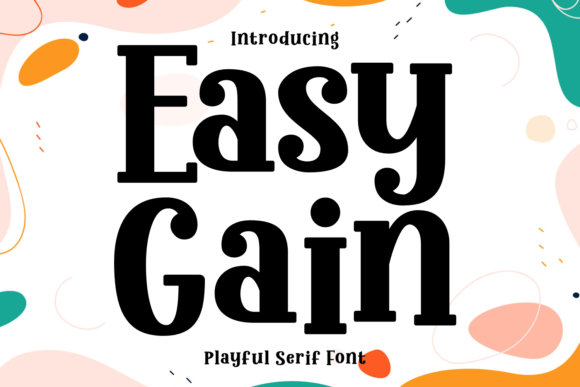
In the vast digital landscape where attention spans are fleeting, typography serves as the silent ambassador of a brand's voice. While minimalist sans-serifs often dominate user interfaces, there remains a powerful demand for typefaces that command space and exude confidence. Enter Easy Gain, a thick and playful slab serif font that challenges the convention of subtlety. Designed with wide characters and chunky serifs, this typeface is engineered not just to be read, but to be seen. It represents a shift toward bold visual communication, bridging the gap between functional legibility and artistic expression.
Understanding the Visual Weight of Easy Gain
To appreciate the utility of Easy Gain, one must first understand the mechanics of the slab serif genre. Historically, slab serifs were designed for posters and advertisements in the 19th century, intended to catch the eye from a distance. Easy Gain modernizes this tradition. Its defining characteristic is its "wide" stance; the characters occupy more horizontal space than standard fonts, creating a sense of stability and groundedness.
The "chunky" serifs—the small strokes at the ends of the main letterforms—add a playful weight to the text. Unlike the sharp, authoritative serifs of a font like Times New Roman, the serifs in Easy Gain are blocky and geometric. This design choice softens the formality of the text, making it approachable without losing its authority. It is this unique blend of sturdiness and friendliness that makes it a versatile tool for designers looking to evoke positive, high-energy emotions.
Strategic Applications: Where Typography Meets Reality
The true value of a typeface is measured by its adaptability across different mediums. Easy Gain excels specifically in environments where high contrast and immediate recognition are required. Its design DNA makes it particularly suited for the following applications:
Apparel and Merchandise
In the world of t-shirt typography, readability is paramount, but so is style. A font that is too thin can get lost in the fabric texture or wrinkle with movement. Easy Gain’s thick strokes ensure that graphics remain crisp and legible, whether printed on cotton, polyester, or hoodies. The playful nature of the font allows for humorous slogans or bold statements to land with visual impact, making it a favorite for streetwear brands and novelty merchandise.
Digital Banners and Advertising
Online advertising is a battleground for visibility. Banner ads often occupy small real estate on a crowded webpage. Designers require a font that can be scaled down without losing definition or scaled up to dominate a hero image. The wide geometry of Easy Gain prevents letters from blurring into one another at smaller sizes, a common issue with overly complex fonts. Conversely, when used in large format headlines, it creates an immersive typographic texture that draws the viewer's eye immediately to the call-to-action.
Packaging and Product Labels
Consider the shelf of a grocery store or a boutique. Consumers scan products in milliseconds. A product label utilizing Easy Gain can leverage its chunky serifs to create a "shelf-shout." Whether it is used for a craft beer bottle, a line of hot sauces, or children's snacks, the font communicates a sense of substance and quality. It suggests that the product inside is robust and full of flavor, utilizing the psychology of visual weight to influence purchasing decisions.
Editorial Design and Posters
Magazines and posters often require a hierarchy where the headline must support the subtext. Easy Gain serves as an excellent anchor for editorial layouts. Because it is so visually distinct, it pairs exceptionally well with lighter, narrower body text. This contrast allows the headline to "pop" off the page, guiding the reader's eye from the title to the introductory paragraph seamlessly.
The Psychology of "Chunky" Serifs
Why does a font like Easy Gain feel so effective in modern design? The answer lies in cognitive psychology. Human brains process shapes and patterns before they process meaning. A "thick" font implies strength, reliability, and permanence. In a digital age dominated by thin, ephemeral lines, a chunky font feels tactile and grounded.
Furthermore, the "playful" aspect of Easy Gain cannot be overstated. The wide stance and rounded potential of the serifs evoke a sense of openness. This makes the font ideal for educational materials or content aimed at a broad audience. It avoids the intimidating rigidity of corporate fonts, inviting the reader to engage with the content rather than just scanning it. For educators and researchers presenting data, using a font like Easy Gain for key statistics or section headers can make dense information feel more accessible and less daunting.
Technical Considerations for Designers
Integrating a display font like Easy Gain into a design system requires a thoughtful approach to balance. Because Easy Gain is wide and thick, it consumes significant visual real estate. Overusing it in body text can lead to a cluttered appearance and "rivers" of white space running through paragraphs.
Designers should adhere to a few best practices when implementing this typeface:
- Limit Body Text Usage: Reserve Easy Gain for headers, sub-headers, and call-outs. Use a clean sans-serif or a standard serif for long-form reading to maintain legibility.
- Adjust Tracking: Because the characters are naturally wide, they may appear spaced out. Reducing the tracking (letter-spacing) slightly can help tighten the text blocks, creating a more cohesive look for headlines.
- Color Contrast: The heavy weight of the font means it absorbs ink or pixel density. Ensure high contrast between the text and the background. A dark Easy Gain text on a light background creates a crisp, stamped effect.
Easy Gain in the Context of Web Design
For web developers and business owners, the choice of font impacts both aesthetics and performance. Easy Gain, when utilized as a web font, can significantly alter the "personality" of a landing page. It moves a website away from the generic "tech-startup" look and toward a more editorial, lifestyle-focused aesthetic.
When implementing Easy Gain on the web, it is crucial to consider load times. Display fonts often contain complex vector data. Developers should utilize modern formats like WOFF2 to ensure the font loads quickly without slowing down the page speed. Additionally, using the font for "above the fold" content ensures that the visual impact is felt immediately upon the user's arrival, reducing bounce rates and encouraging deeper exploration of the site.
Comparative Analysis: Easy Gain vs. Traditional Serifs
To understand the niche Easy Gain occupies, it helps to compare it to traditional serif families. Traditional serifs, such as Garamond or Baskerville, are designed for readability in long-form text. They have varying stroke widths (thick and thin transitions) that guide the eye along the line of text.
Easy Gain, conversely, often maintains a more consistent stroke width, similar to a sans-serif but with the added terminal bars. This makes it function almost like a hybrid. It possesses the structural integrity of a serif but the graphic punch of a bold sans-serif. This hybrid nature makes it superior for short-form content where impact is more important than fluency.
Creative Workflow: From Concept to Execution
For creators and hobbyists looking to utilize Easy Gain, the workflow begins with understanding the mood of the project. This font thrives in environments that celebrate boldness. A workflow for utilizing this typeface might look like this:
- Conceptualization: Identify if the project requires a "loud" voice. Is it a sale banner? A vintage-style logo? A bold statement piece?
- Pairing: Select a secondary font. A geometric sans-serif often pairs well with the blocky nature of Easy Gain, providing a clean counterpoint to the serif's texture.
- Hierarchy Definition: Use Easy Gain for the primary message. Let it dominate the top tier of the visual hierarchy.
- Color Palette Selection: Choose colors that complement the heavy visual weight. Bright, saturated colors often work well, amplifying the "playful" characteristic of the font.
The Role of Typography in Brand Identity
For business owners, choosing a font like Easy Gain is a branding decision. It signals that the brand is approachable, confident, and perhaps a bit irreverent. It is a departure from the stiff, corporate typography of the past. In an era where consumers crave authenticity and personality, a typeface with distinct character can be a differentiator.
Consider a local bakery, a gym, or a creative agency. Using Easy Gain on their signage and menus immediately sets a tone. It tells the customer, "We are here, we are substantial, and we don't take ourselves too seriously." This emotional connection, facilitated by typography, is a subtle but powerful driver of brand loyalty.
Future Trends: The Return of the Heavy Serif
Trends in typography are cyclical. We are currently seeing a resurgence of maximalism and retro-aesthetics in design. The "chunky" look is in vogue, not just in fonts, but in illustration and UI design (think of the bold buttons on modern apps). Easy Gain fits perfectly into this trend. It offers the retro charm of vintage signage while maintaining the clean lines required for modern digital reproduction.
As screen resolutions increase and print technology advances, the ability to render thick, complex fonts cleanly has improved. This technical capability encourages the use of fonts like Easy Gain, allowing designers to push the boundaries of visual density without sacrificing quality. It represents a move away from the "thin and light" aesthetics that dominated the early 2010s, returning to a design philosophy that values presence and texture.
Final Thoughts on Implementation
Whether you are a researcher designing a presentation, a creator making a poster, or a developer building a landing page, Easy Gain offers a specific solution to a common problem: the need to be noticed. Its wide characters and chunky serifs are not merely stylistic choices; they are functional tools for communication. By understanding its characteristics—its visual weight, its playful nature, and its versatility—users can leverage this font to create designs that are not only readable but memorable.
In the end, typography is about the relationship between the writer and the reader. Easy Gain simplifies that relationship, removing ambiguity and replacing it with bold, unapologetic clarity. It is a font that doesn't just sit on the page; it commands the space it occupies.