Moonlight Signature: Balancing Script Elegance with Digital Precision
When searching for a monoline script font, the primary challenge often lies in finding a typeface that retains the authentic, fluid motion of handwriting without sacrificing the structural integrity required for modern digital and print applications. Many script fonts fall into two categories: those that are too messy and unpredictable for professional branding, and those that are so rigid they lose the personal touch of a signature. Moonlight Signature, designed by Rotterlab Studio, occupies a distinct middle ground in this landscape. It is a sophisticated monoline script that prioritizes technical precision while emulating the natural movement of cursive strokes.
Understanding the Monoline Consistency
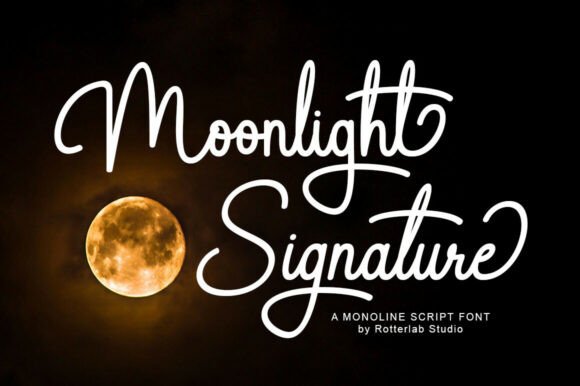
The defining characteristic of Moonlight Signature is its uniform line weight. Unlike traditional calligraphy fonts that utilize high contrast between thick downstrokes and thin upstrokes, Moonlight Signature maintains a consistent width throughout every curve and connection. This monoline consistency creates a clean, minimalist aesthetic that is particularly effective in contemporary design contexts.
For designers and brand strategists, this consistency solves a common readability issue. Variable-weight script fonts can sometimes break down or appear cluttered when rendered at small sizes, particularly on low-resolution screens. Moonlight Signature’s steady stroke width ensures that the text remains legible even in smaller applications, such as photo watermarks, social media bios, or packaging details. However, it is worth noting that this lack of contrast can also be a tradeoff. If a project requires high drama, calligraphic flair, or a vintage "pen-on-paper" texture, a monoline approach may feel too sterile or geometric compared to a brush script.
Technical Precision vs. Organic Flow
One of the most challenging aspects of script typography is the connection between letters. In many digital scripts, the transition from one letter to the next can feel abrupt or unnatural. Rotterlab Studio has addressed this by designing Moonlight Signature with specific attention to the flow of ascenders and descenders. The font features sweeping loops and expressive tails that allow for a natural rhythm.
When evaluating this font against other options in the market, consider the concept of "controlled chaos." Some alternatives offer a more raw, scratchy texture that mimics a hurried note, while others are overly polished to the point of looking like a logo rather than a typeface. Moonlight Signature leans toward the polished end of the spectrum without becoming stiff. It functions effectively as a signature font, where the goal is to simulate a personal mark, but it is also structured enough to be used for short headings where clarity is paramount.
PUA Encoding and Accessibility
A practical consideration for any designer is software compatibility. Moonlight Signature is fully PUA (Private Use Areas) encoded. This technical detail is significant because it means that all glyphs, swashes, and alternate characters are accessible regardless of the design software being used. Whether you are working in Adobe Illustrator, Photoshop, or even basic text editors that do not support OpenType features, you can still access the stylistic alternates. This makes the font a versatile resource for users who may not have advanced typographic skills or software, effectively lowering the barrier to entry for creating professional-looking typography.
Ideal Use Cases and Applications
Determining if Moonlight Signature is the right choice depends largely on the specific context of your project. Its strengths are most evident in scenarios where personalization needs to coexist with professionalism.
- Branding and Identity: It is well-suited for boutique businesses, lifestyle brands, and personal logos. The clean lines project a sense of modern elegance that works well for fashion, beauty, or wedding-related industries.
- Digital Content: For social media graphics, the font offers a distinct personality that stands out against standard sans-serif typography without being illegible in fast-scrolling environments.
- Stationery and Packaging: The uniform weight makes it excellent for foil stamping or embossing, as the consistent line width ensures even pressure or ink distribution.
However, for long-form text or body copy, Moonlight Signature is not advisable. Like most script fonts, extended reading of cursive text causes eye fatigue. It is best reserved for headlines, pull quotes, or accent text. If your project requires a script that mimics rough pencil sketches or heavy ink brushes, this font’s refined and smooth nature may not provide the gritty texture you need.
Evaluating Tradeoffs and Alternatives
When comparing Moonlight Signature to other resources, it is helpful to categorize fonts by their "temperature." Moonlight Signature is a "cool" and "calm" script. It does not scream for attention; rather, it whispers with confidence. If your design requires a high-energy, explosive script often seen in sports branding or streetwear, a different category of typeface would be more appropriate.
Furthermore, while the font includes uppercase and lowercase letters for typographic versatility, the style is inherently connected. This means that while you can create hierarchy through size or weight, the connected nature of the script limits how much spacing you can add between letters (kerning) without breaking the visual flow of the cursive connections.
Conclusion: Is Moonlight Signature the Right Fit?
Choosing a font is rarely just about aesthetics; it is about functionality and fit. Moonlight Signature offers a reliable solution for those who need the warmth of a handwritten signature combined with the predictability of digital engineering. It removes the guesswork often associated with script fonts—no broken connections, no illegible loops, and no software compatibility issues.
If your goal is to create a visual identity that feels personal, approachable, and modern, Moonlight Signature is a strong contender. It bridges the gap between the organic nature of human writing and the structured requirements of digital design, offering a balanced tool for a wide range of creative applications.